Job Search · Interview
Cake Business PM Interview: Full Process & Presentation
This is the record of my first full-time job. It starts with a LinkedIn message and ends with a signed contract, covering the final presentation, the same-day offer, and every clause we actually worked through together. A few things about this process were different from the typical flow, and I'm writing them down for anyone who might go through something similar.
What Cake Does
Before getting to the interview itself, let me put the company in context. Cake is a talent platform for the Asia-Pacific market, integrating resumes, job listings, employer branding, and AI tools in a single product. Taiwan is one of its core markets, and the company is actively expanding into Japan and Southeast Asia. For a more precise overview, the official Cake company page is more accurate than anything I'd write here.
I'm starting here because most people's first impression of Cake stops at "resume tool." But what this interview process revealed was much bigger than that: they're doing market development and strategy across Asia-Pacific, and the kind of person they need is harder to describe than any single job title suggests. That combination of challenge and uncertainty was part of what drew me in.
There was another dimension that resonated with me personally. At EdYouth, the thing I cared most about was helping high school students find what they actually wanted to do. Cake's platform does something similar at a larger scale: helping people at different career stages find where they belong. Getting to push that forward from the inside was another reason I took the role.
The LinkedIn Invite and the Waived HR Round
I didn't apply for this job. Cake's talent acquisition team found me on LinkedIn and sent a message asking if I'd be interested in a conversation. The function I was joining was the business team: commercial strategy and market expansion, which is closer to a hybrid Project Manager/consulting role than a typical sales position.
For how to build a LinkedIn presence that gets people reaching out, I wrote a separate piece on LinkedIn cold outreach and coffee chats. I won't repeat it here. But this experience confirmed once again that treating LinkedIn seriously as your own landing page actually pays off.
One unusual thing about the process
The standard HR screening round was waived in my case. HR later told me that my responses during the back-and-forth felt "engaged and well-matched," so the usual 30-minute background check was skipped. What I thought was just a casual coffee chat to learn more about the role turned out to be the screening itself.
On the surface this just saved one round. But it was actually a signal about how they operate: the process isn't run by the book, and they make judgment calls based on the quality of early interactions. The tempo of everything that followed was consistent with this first impression.
One-on-One with the COO: Taking Time to Explain Yourself
The second round came faster than I expected. A few days after the coffee chat, a one-on-one with the COO appeared on my calendar. I later understood this is just Cake's speed: when the fit feels right, they move quickly. I liked that. It meant they were taking the process seriously too.
There was no case in this round. It was mostly about me. I spent most of the time talking through my experience building EdYouth from scratch: how a campus problem became a cross-school student organization, how we raised money, how we built the team, what we got wrong, and why I eventually decided to leave. The COO said afterward that this was the part that made him most interested in continuing the conversation.
Neither side was rushing toward a conclusion. We spent a lot of time aligning on each other: what I wanted to do, what they hoped the role would grow into, what problems I'd actually be working on in the first year. Walking away from that conversation, what I felt most clearly was that I'd been paid attention to, not evaluated.
"What they're looking for isn't just what you can do, but whether your past choices have a logic of their own."
Final Presentation: Putting McKinsey Deck Skills to Use
The same day the second round ended, I received the final presentation brief: prepare slides on a given topic, submit as a PDF by 10am the day before the interview, with late submissions (without prior notice) counted as a withdrawal. From brief to presentation day was under a week.
I first scheduled a walkthrough call to confirm the brief's scope and expectations. This wasn't an interview: it was more like calibrating direction. If you reach this round, I'd strongly recommend booking that call instead of guessing what they're looking for.
When preparing, I made a deliberate choice: rather than building slides that sounded right, I'd build something I actually had a point of view on and could be pushed on. Surface-level polish wouldn't hold up under follow-up questions.
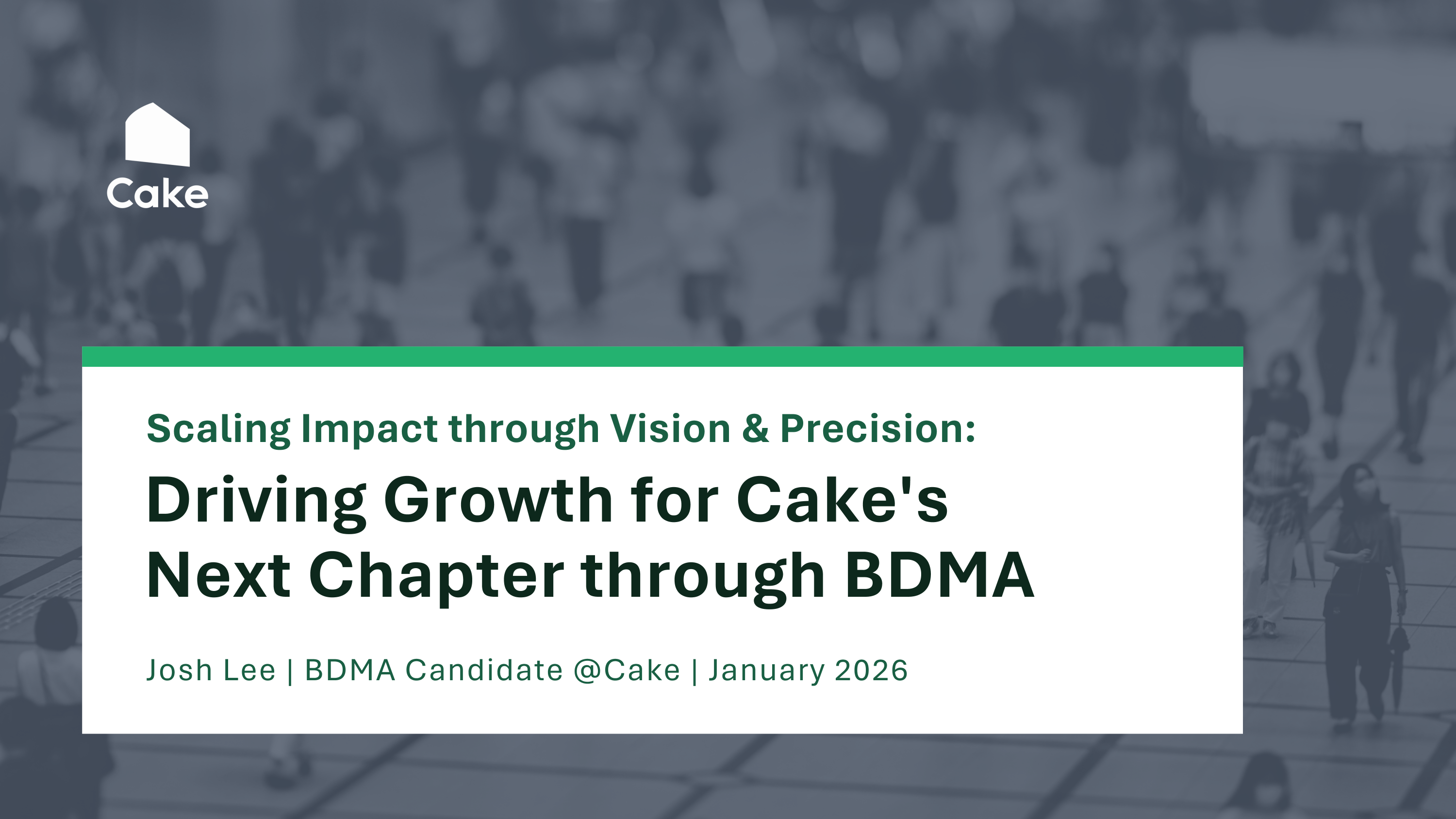
The deck skills behind this go back to McKinsey. The case prep sessions during the internship, and every time a colleague reviewed my slides, directly transferred to this Cake round and to other interviews that followed. I won't claim to be a top-tier deck builder, but I understand what a good deck looks like. That baseline came from McKinsey.
The interview itself didn't feel like an evaluation. It felt more like working through a real problem together. After the presentation, there was about five minutes of internal discussion. Everyone nodded, and the offer arrived the same day. That decision speed is the thing I remember most from the entire process.
After the Offer: What We Actually Discussed
I didn't sign immediately. I took time to go through the contract clause by clause with Cake. I'm not going to frame this as due diligence: it was simply getting both sides onto the same page. Below is a table of the items I actually discussed, as a reference for others who are at this stage for the first time:
| Item | What it covers |
|---|---|
| Annual Salary | Base salary amount, monthly breakdown, and payment schedule |
| Bonus | Structure and conditions for performance, quarterly, and annual bonuses |
| Insurance | Coverage under health insurance, labor insurance, and group commercial insurance |
| Overtime Pay | How overtime hours are counted, and how compensatory leave and overtime pay are calculated |
| Leave | Accrual and usage rules for annual leave, sick leave, and statutory leave |
| Device Policy | Rules on company equipment use and data protection requirements |
| Non-Compete | Duration, geographic and industry scope, and compensation clause |
| Other Benefits | Training subsidies, team activities, holiday gifts, and miscellaneous perks |
I also spent an hour having a lawyer review the contract. For anyone signing their first full-time offer, this is money very well spent. A lawyer won't tell you whether you're being exploited: they'll tell you which clauses are vague enough to create problems later, and where the wording currently favors the employer. These are things you can't see on your own.
For People Who Receive an Invitation: What Mindset to Bring
I get asked often why I chose Cake over McKinsey. The honest answer is timing: Cake's process concluded first and the offer arrived first, and I wanted my first full-time job to be a chance to try a different field and a different kind of work. I genuinely liked the people at McKinsey and what I learned there, and I hope to cross paths with them again in various ways. But Cake came first, and at that point I already knew where I was going next.
So rather than writing about which company to choose, I'd rather write about the mindset I think is worth bringing when an invitation arrives. Here's what I'd tell my past self:
- Take every opportunity, don't pre-filter: A lot of people screen out opportunities based on company size, industry heat, or job title before they actually understand them. What you'll learn and who you'll meet can't be predicted from those surface factors. Be willing to have the conversation first, then decide.
- Be humble, be curious: Don't go in evaluating their company, and don't try to prove you're better than they expected. Put your curiosity into understanding what problem they're actually solving. That posture takes you further.
- Communicate proactively, ask questions, but set your own limits: Asking questions is a sign of genuine interest. But alongside that, know in advance what you won't compromise on (salary floor, team culture, room to grow), so you don't get swept along by the energy of the moment.
- Put time into your LinkedIn profile: It might land you a job someday :) This entire process started with one inbound message. Write clearly about your background, past projects, and what you're interested in. It will help a future recruiter who hasn't met you yet.